Thursday, September 9, 2010

story telling & editing

This ENTIRE movie was pretty much hella tweaked, rebuilt, and rewritten during the editing process. Some of the story concepts that seemed pretty cool on paper just didn’t end up translating all that well on screen... so measures had to be taken.
Scenes were shuffled, moved, and split LIKE CRAZY... since a good part of the story is told in non-linear flashbacks, there was a lot to play around with and no real ‘wrong’ way of presenting things. The real time part of the tale remained linear, but any part of the story that didn’t have to be exactly set in time became fair game for being shuffled around. The non-linear or FLASHBACK sequences we’re placed every which way possible until just the right combination was found to give the story proper flow, comprehension, and sense of magic. Yeah, the first half of the movie was pretty much Frankensteined, inclusive of actually pulling lines from one scene and sticking them into another.
The second half of the flick presented a whole nother slew of issues. The movie becomes linear at this point(though flash backs in the original script went well into the second half of the flick), many of the scenes ‘felt’ long, slowing the movie down big time. So lots ‘o lines got cut, and lots of scenes got cross cut with other scenes. Any dialog that didn’t serve the story got axed, yeah this included lots ‘o funniness, but if it didn’t have to be there... GONE. In order to make the story pop and flow scenes featuring different characters taking place at the same time in different locations were cross cut. Longer scenes became many shorter scenes intercut between each other. Once again lines were pulled from one part of a scene and moved into another.
The goal is ALWAYS to make the best, most entertaining movie possible. So going to what ever lengths, and taking what ever time necessary to get there was a given. Being independent and answering to like, NO ONE, means we have that time... and though it’s taken a lot of blood, sweat, and tears... ultimately FOUND A WAY of making this movie work in an entertaining, magical way.

Tuesday, August 10, 2010

Thursday, August 5, 2010

editing on FCP

The movie was, and still is, edited with Apple’s Final Cut Pro, which is the gold standard for indie filmmaking. FCP is fairly easy to use and once familiar with, can pretty much cut at the speed of thought.
EVERYTHING we shot got ingested, almost two whole terabytes of raw data. The footage was then separated into scenes, set ups, and takes. Proper documenting is the most important element of editing. The time you spend sorting stuff out up front saves WAY more time figuring stuff out later.
Each scene got it own sequence, making it easy to logically jump around the footage. The ‘final cut’ actually ended up being nothing like the original script, so having all these sequenced scenes at your finger tips proved to be very handy.
EVERY zero and one of digital HD footage was looked at. First cut being the ‘string out’, or every scene laid out in it’s entirety in the exact order of the script. String out number one totally SUCKED, causing the director to go on suicide watch. BUT, this is just a starting point, NOT the finished movie, what happens before all the hours, hours, and HOURS of tweaking needed to get everything just right.
Biggest bitch was dealing with continuity, performance was top consideration, mostly trumping continuity in the decision making process. Lighting, great ad-libbing, and sound we’re factored in as well.
All in all it took getting up to version a 5.2 to get to picture lock.

Sunday, July 18, 2010

work flow

One of many things that can make or break a production, especially when going at break neck speed, is work flow. How images get in and out of the camera, then into an editing program.
What really saved our butts was SD memory cards(the same ones used in digital cameras), the format of the Panasonic HMC150. A 32 & 16 gig card gave us over 6 hours worth of recording time. Thus never having to stop to down load footage, bring an extra lap top, or hard drive, which would have been the case using the P2 format.
Each night after shooting, the SD cards were plugged into an adaptor(same one used with digital cameras and cell phones) plugged into the USB port of a mac pro tower. The footage was imported, binned, and documented before being backed up on a second hard drive. The SD cards were then cleared for the next day of shooting. Made for some pretty long nights, but luckily the ingesting was able to be multi-tasked along with documenting and binning. Backing up was done over night, clearing the SD chips early the next day.
Over all this work flow ‘worked’ pretty well. There was some downloading on set the days we were using the X200 camera with P2 cards. The only downtime when actually shooting was waiting for the SD cards to be cleared when they weren’t. Easy workflow is one good reason to shoot with an HMC150.

Friday, July 9, 2010

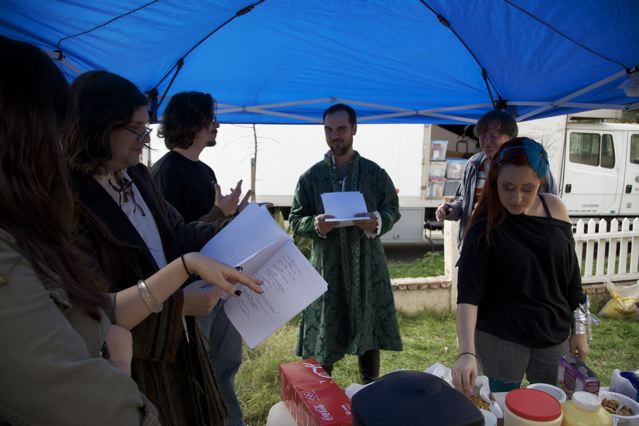
SHOOT RECAP - continuity

If there was one thing, just one thing, to have more use of during this shoot(besides of course TIME) it would not be camera gear, locations, lights, grips, gaffers, craft service, or sound equipment... it’d be... FULL TIME continuity.

Oh how this little project would have gone so much smoother with someone, taking note of all those actors being here, there, who’s hand was doing this, head turned like that. Yes, you can edit around this stuff when ya got lots of coverage, but shooting up to ten pages a day didn’t allow much of that. The actors did remarkably well, considering, but still TOTALLY paid in post... totally...
Paid in other ways too with basically no one keeping track of all those lines of dialog? In one example, the script had to actually be modified, solely to fix when one of the actors referred to on thing one way here and another way there... a flub that would need no correcting if we had a freaking continuity person.
Yes, the Real Deal had his crew were constantly taking pictures of sets, but props still kept moving around all over the place. A continuity person, any continuity person, would have been just what the Real Deal needed to keep his peeps spending more time on their real jobs.
And speaking of real jobs, it was left to the actors to keep track of their wardrobe, where and when. Luckily, our story takes place during a small amount of time, meaning very little ‘costume’ changes. But sure would have ben nice having someone besides an actor keeping track of all that stuff.
Having said all that, we actually did have a continuity person for about two days, inclusive of the 11 page mother of all scenes when we REALLY needed it.... and needless to say for those two days, Tom was the most popular person on set.
photos by Suzan Jones